From moisture-activated dressings in the 1980s to controlled-release formulations in China in 2026, a look inside the inventions that sought to bring chlorine dioxide into wound-care technology.
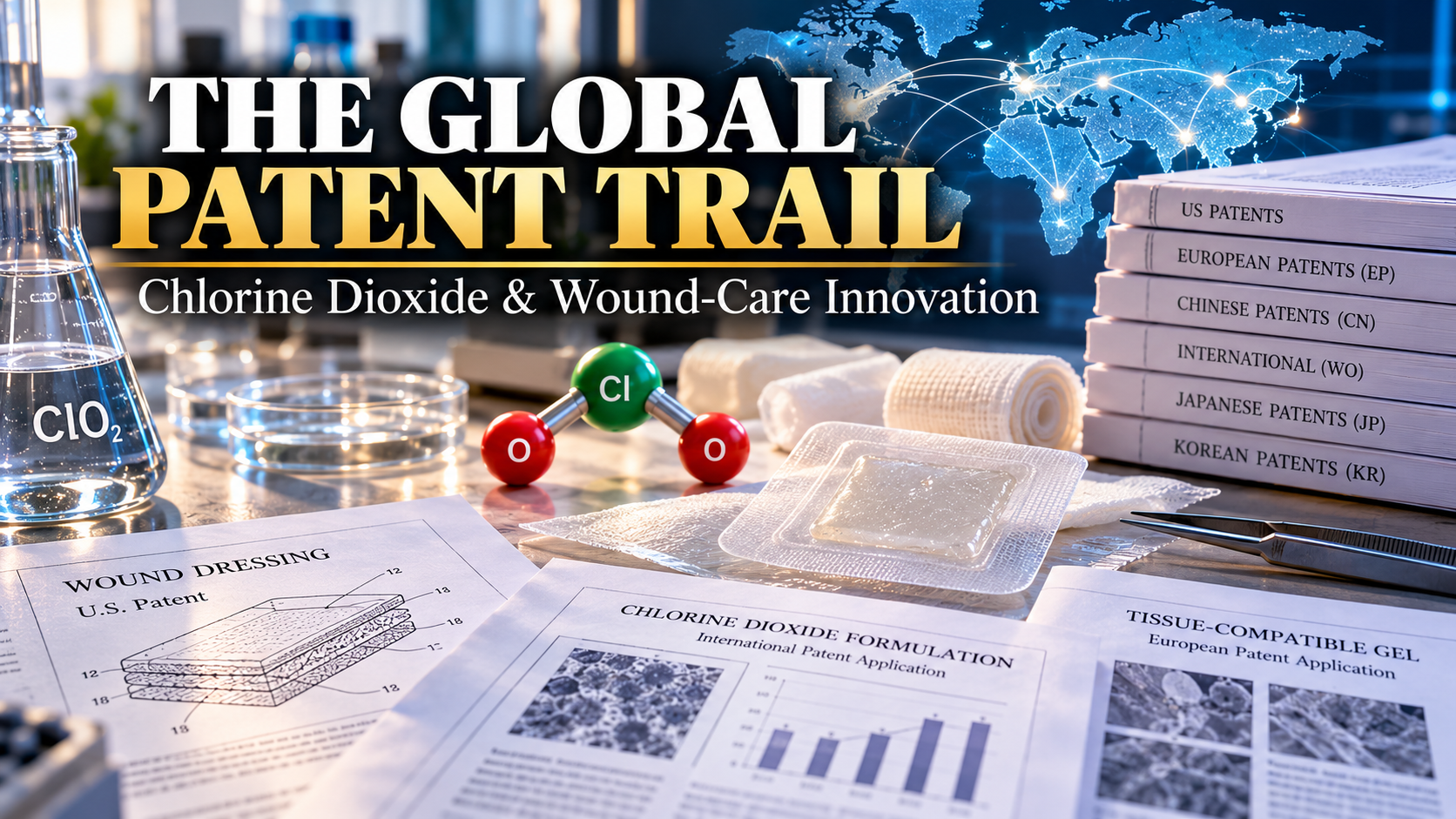
What happens when inventors begin looking at a familiar chemical through an entirely different lens?
Chlorine dioxide is widely recognized for its antimicrobial properties and its established role in water treatment and disinfection. But a search through international patent records reveals another history—one involving wound dressings, surgical irrigation systems, topical gels, tissue-compatible formulations, and increasingly sophisticated methods of delivering chlorine dioxide where inventors believe it may be useful.
Some of these inventions are more than thirty years old. Others are surprisingly recent.
The interesting story isn’t simply that patents exist. It’s how the underlying ideas have evolved, the technical problems inventors have attempted to overcome, and the experimental findings disclosed along the way.
The Early Years: A Wound Dressing Activated by Moisture
One of the earliest inventions in this investigation traces its priority date to November 21, 1989.
The patent, US5104660A — Method of Preparing an Antimicrobial Wound Dressing, describes a layered dressing designed to generate chlorine dioxide when exposed to moisture from a wound.
Rather than storing an already activated chlorine dioxide solution, the inventors proposed separating reactive components within the dressing until moisture brought them into contact.
The design incorporated absorbent dressing materials and an activation mechanism intended to generate antimicrobial activity directly at the wound site.
This was an interesting departure from the familiar concept of applying a liquid disinfectant.
The inventors were envisioning a medical material that could perform a chemical function after being placed in its intended environment.
A related patent, US5227168A — Method of Treating a Wound, was granted in 1993. Its inventors, Milos Chvapil and Bruce Barber, were associated with work subsequently assigned to Healx Corporation.
Together, these records document an early effort to incorporate chlorine-dioxide-generating chemistry into wound dressings rather than rely exclusively on separately prepared solutions.
The broader question was already taking shape: Could the chemistry be incorporated into a medical material in a way that controlled when and where its antimicrobial activity became available?
The 1990s: Surgical Wounds and Internal Irrigation
By 1997, another approach had appeared.
US5622725A — Wound Disinfection and Repair, invented by Robert D. Kross and assigned to Alcide Corporation, describes chlorine dioxide formulations intended for wound irrigation, including surgical sites and the peritoneal cavity.
The application traces its priority history to March 1992.
Its proposed uses extended beyond surface disinfection to situations involving surgical wounds, catheter-associated infections, and irrigation of internal body cavities.
A particularly important aspect of the invention was its attention to the chemical composition of the solution.
The patent discussed limiting residual chlorite and controlling other formulation characteristics to address concerns about tissue irritation.
That detail reveals a recurring theme in this patent history.
The inventors were not treating all chlorine dioxide preparations as interchangeable. They were attempting to distinguish between chemical formulations based on how they might interact with living tissue.
The patent includes descriptions of laboratory observations and proposed biological effects. Those descriptions provide evidence of what the inventors investigated and claimed, although they do not independently establish clinical effectiveness or safety.
Still, the technical direction is notable: chlorine dioxide was being considered not merely as an environmental disinfectant but as a component of specialized medical irrigation technology.
Solving the Stability Problem: Chlorine Dioxide Gels
Another challenge soon became apparent.
How could an unstable, reactive antimicrobial agent be incorporated into a preparation that would remain useful during storage and application?
The patent US6039934A — Use of Xanthan Gum for Gelling ClO₂ and Related Species describes an approach using xanthan gum as a gelling agent.
The concept was to create formulations suitable for skin and wound disinfection while addressing chemical instability and the limitations associated with certain acidic or salt-containing preparations.
A related international publication, WO2001064174A1, shows how this formulation concept entered the international patent system.
The patent describes the use of a gel structure intended to maintain the formulation’s practical usefulness while resisting degradation from its reactive ingredients.
This is an important development because the physical form of a medical preparation can matter almost as much as its active ingredient.
A liquid may flow away from the intended area. A gel may remain in contact with a surface longer. A dressing may provide an entirely different method of localized delivery.
The inventive challenge was therefore not simply to produce chlorine dioxide, but to develop a usable medical formulation around its chemical characteristics.
A More Sophisticated Question: Can Antimicrobial Activity Be Separated from Tissue Damage?
By the following decade, patent documents were increasingly addressing a fundamental problem in wound care.
A substance capable of damaging microorganisms may also damage healthy cells.
How might inventors preserve useful antimicrobial activity while reducing unwanted effects on surrounding tissue?
US8524201B2 — Non-Cytotoxic Chlorine Dioxide Fluids, granted in 2013, examines this challenge through formulations designed to limit cytotoxicity.
The patent discusses the role of accompanying oxychlorine compounds, solution chemistry, and tissue compatibility.
Importantly, it also contains experimental wound data.
In one experiment, researchers compared wound contraction following treatment with several chlorine dioxide formulations against untreated controls.
The results are especially interesting because they did not show accelerated wound contraction.
The reported measurements were:
| Experimental group | Wound contraction |
| Chlorine dioxide gel, formulation 1 | 55.84% |
| Chlorine dioxide gel, formulation 2 | 56.92% |
| Chlorine dioxide solution | 50.10% |
| Untreated control | 57.49% |
The patent reports that the differences were not statistically significant.
Rather than concluding that the formulations accelerated healing, the inventors interpreted the findings as indicating that their experimental preparations did not adversely affect the measured rate of wound contraction.
That distinction matters.
A patent can be scientifically interesting even when a particular experiment does not demonstrate a dramatic improvement.
In this case, the inventors were investigating whether a formulation could provide antimicrobial properties without interfering with an important aspect of wound healing.
That is a different technical question from whether chlorine dioxide directly stimulates tissue regeneration.
European Patent Activity: Delivering Chlorine Dioxide to Biological Tissue
The international record also includes EP2393499A2 — Chlorine Dioxide Treatment for Biological Tissue.
This European publication describes specialized delivery approaches for contacting biological tissue with chlorine dioxide preparations.
The disclosed experiments include comparisons of different methods of applying chlorine dioxide to experimental wounds, including gels and irrigation systems.
Some of the experiments assessed bacterial contamination in wound tissue following treatment.
The patent therefore reflects a shift from the question of whether chlorine dioxide possesses antimicrobial activity to the engineering problem of how best to deliver that activity to a biological surface.
The associated American patent, US8703106B2, was granted in 2014.
These American and European records illustrate another important feature of international patent research: multiple publications may describe related inventions or belong to the same patent family.
Counting them separately without examining their relationships could exaggerate the number of independent innovations.
Nevertheless, their technical descriptions reveal substantial attention to delivery systems, formulation characteristics, and experimental evaluation.
Wound Dressings That Incorporate Chlorite
A different line of development appears in WO2012106822A1 — Wound Dressings Comprising Chlorite, published internationally in 2012.
Related applications appeared in the United States, Canada, and Europe.
This invention focuses on incorporating chlorite into absorbent wound-dressing materials while maintaining stability during storage.
Although chlorite is chemically related to chlorine dioxide, it is not identical to chlorine dioxide itself. That distinction is important when categorizing the inventions.
The patent describes stabilizing chlorite-containing dressings by controlling the chemical environment of the absorbent material.
The technical challenge is familiar: reactive chemistry may be useful in a wound-care product, but that chemistry must remain sufficiently stable before the product is used.
This patent family belongs in the broader investigation because it illustrates how inventors have explored related oxychlorine chemistry in medical dressings.
It should, however, be identified as a chlorite-based invention rather than automatically counted as a direct chlorine dioxide treatment.
China, 2026: A New Approach to Controlled Release
One of the most recent discoveries comes from China.
A wound treatment agent and its preparation method — CN121971692A was published on May 5, 2026, following a March 23, 2026 filing.
The application identifies Beijing Xinyuan Hengxin Medica as the original applicant.
Its proposed invention involves using polyvinylpyrrolidone, commonly abbreviated PVP, to stabilize chlorine dioxide within a wound-treatment formulation.
According to the patent abstract, the inventors envision a preparation that maintains chlorine dioxide in a stabilized form and gradually releases it upon contact with wound fluids.
The stated goals include localized antimicrobial activity, reduced irritation associated with acidic activation, and support for wound management.
The application also describes different formulation possibilities, including gels and liquid preparations.
This is particularly interesting when viewed alongside the much older patents.
The earliest inventions explored moisture-activated dressings. Later patents investigated gels, tissue compatibility, and specialized delivery devices. This Chinese application proposes another method of stabilizing and releasing chlorine dioxide in response to the wound environment.
That does not mean the newer invention has demonstrated superior clinical performance. The application is pending, and its technical claims require separate evaluation.
But it does show that the engineering questions surrounding chlorine dioxide and wound care remain active more than three decades after the earliest filings in this investigation.

What the Patent Trail Reveals
Across these records, several recurring themes become visible.
First, inventors have repeatedly explored localized antimicrobial delivery.
Their designs include dressings, gels, irrigation systems, and formulations intended to act at particular biological surfaces.
Second, chemical stability has been a persistent challenge.
Several inventions address how to store, stabilize, or generate reactive oxychlorine compounds at the intended time and location.
Third, tissue compatibility has received explicit attention.
Patents discuss irritation, cytotoxicity, accompanying chemical species, and the effects of formulations on wound tissue.
Fourth, the inventions are not confined to one decade or one patent jurisdiction.
The records span the late 1980s through 2026, with related filings appearing in North America, Europe, and China.
And fifth,
some patent documents contain experimental observations that are valuable to examine independently of the patent’s commercial or legal significance.
The 2013 wound-contraction findings provide a good example. They illustrate how a seemingly unremarkable experimental result can clarify the particular problem an inventor was attempting to solve.
Is This Evidence of Serious Investment?
Patent activity can reveal a willingness to devote resources to an invention. Preparing and prosecuting patent applications generally requires technical documentation, legal work, and financial commitments. Pursuing protection across multiple countries can involve additional costs.
Repeated filings and subsequent technical developments may suggest sustained interest. However, patent records alone cannot tell us how much money an inventor or company spent on research, whether a product reached the market, or whether a medical application ultimately proved effective.
Those questions require additional evidence, such as corporate disclosures, licensing records, product documentation, clinical studies, and regulatory records.
What the patents do establish is that inventors and organizations have repeatedly sought legal protection for specific technologies involving chlorine dioxide or closely related chemistry in wound-care applications.
That is a documented history of technological exploration—not merely a collection of informal suggestions.
An Unexpected Story of Medical Innovation
The familiar public discussion of chlorine dioxide tends to revolve around its disinfectant properties, safety concerns, and controversial health claims.
The patent record presents a different perspective. It reveals inventors asking practical engineering questions:
Could chlorine dioxide be generated within a dressing? Could a gel keep it where it is needed? Could a formulation be designed to limit unwanted effects on healthy tissue? Could wound fluids themselves participate in a controlled-release mechanism?
Those questions have inspired a succession of inventions over more than thirty years.
Some approaches were patented. Others remained applications. Some included experimental observations, while others principally described proposed technologies.
Taken together, they reveal a history of continuing interest in applying chlorine dioxide chemistry to wound-care technology. And perhaps the most intriguing finding is that the story is not confined to the past.
In 2026, inventors are still proposing new ways to address the same underlying challenges that appeared in patents decades earlier.
The result is a compelling example of how an established chemical can continue to inspire new technological possibilities long after its original applications become familiar.
Original Patent References
- US5104660A — Method of Preparing an Antimicrobial Wound Dressing
- US5227168A — Method of Treating a Wound
- US5622725A — Wound Disinfection and Repair
- US6039934A — Use of Xanthan Gum for Gelling ClO₂ and Related Species
- WO2001064174A1 — The Use of Xanthan Gum for Gelling ClO₂ and Related Species
- EP2393499A2 — Chlorine Dioxide Treatment for Biological Tissue
- WO2012106822A1 — Wound Dressings Comprising Chlorite
- US8524201B2 — Non-Cytotoxic Chlorine Dioxide Fluids
- US8703106B2 — Chlorine Dioxide Treatment for Biological Tissue
- CN121971692A — A Wound Treatment Agent and Its Preparation Method
Research note: This article examines publicly available patent documents and the technological concepts they disclose. Patents are not clinical approvals or independent confirmation of medical efficacy. Patent descriptions, experimental findings, and granted claims are distinct forms of evidence. Chlorine dioxide formulations should not be applied to wounds or internal tissues outside appropriately evaluated medical products and professional care.