At first glance, chlorine dioxide and osteoporosis seem to have very little to do with one another. Osteoporosis happens in the bones. Chlorine dioxide is an oxidizing antimicrobial best known for water treatment. So when people report improvements in osteoporosis while using chlorine dioxide, an obvious question arises: How could chlorine dioxide possibly get to the bones and do anything useful there?
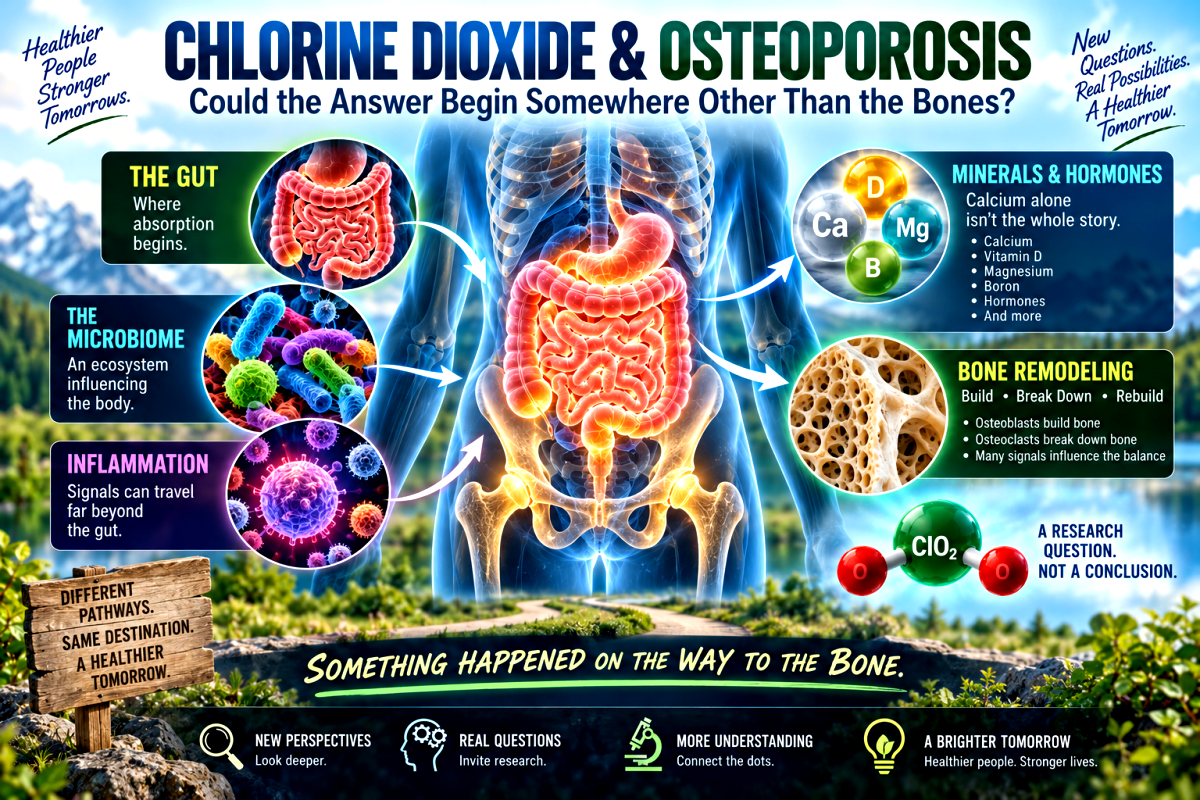
Maybe that question starts us in the wrong place. Osteoporosis is diagnosed in the skeleton, but many of the processes that determine whether bone is gained or lost happen elsewhere in the body. And scientists increasingly have a name for one particularly fascinating connection: the gut-bone axis.
That may give us a very different way to think about the reports surrounding chlorine dioxide—not as proof that chlorine dioxide treats osteoporosis, but as an intriguing question about what might be happening upstream.
Osteoporosis Is the Destination, Not Necessarily the Starting Point
We tend to think of osteoporosis as one disease. In reality, people can arrive at weakened bones by very different roads. Bone is living tissue. Throughout life, old bone is continually removed and new bone is continually constructed.
Two major players are: Osteoclasts, which break down old bone. And Osteoblasts, which build new bone.
Healthy bones depend on keeping this remodeling process reasonably balanced. Anything that persistently tips the balance toward excessive breakdown or inadequate rebuilding can eventually contribute to osteoporosis.
That “anything” is where the story gets interesting.
Same Bones. Different Roads.
Imagine six roads all leading to the same destination marked OSTEOPOROSIS.
Road One: Gut and Absorption Problems
Celiac disease, inflammatory bowel disease, gastrointestinal disorders and other malabsorption problems can interfere with the body’s ability to obtain or use nutrients important to skeletal health.
Calcium matters. Vitamin D matters. Magnesium and phosphorus matter. Protein matters.
But simply consuming these nutrients doesn’t guarantee that everything downstream is working properly.
Road Two: Inflammation and Autoimmune Disease
Rheumatoid arthritis, lupus, inflammatory bowel disease, and other inflammatory conditions are associated with increased osteoporosis risk.
Chronic inflammatory signaling can influence the biological machinery controlling osteoblasts and osteoclasts.
The bones may be where the damage becomes visible. But the original disturbance may be somewhere else.
Road Three: Hormones
Menopause is an obvious example. Declining estrogen profoundly changes bone remodeling. But thyroid, parathyroid and sex-hormone abnormalities can also affect skeletal health.
This is why two people with virtually identical DEXA results might have very different underlying problems.
Road Four: Prescription Medications
Sometimes the treatment for one problem contributes to another. Long-term glucocorticoid use is a particularly well-established cause of medication-induced osteoporosis. Other medications can also influence skeletal health through different pathways.
In this case, there doesn’t need to be an infection, intestinal problem, or unusual microorganism involved at all.
Road Five: Nutrition and Lifestyle
Smoking, heavy alcohol consumption, inadequate nutrition, low body weight, inactivity, and inadequate mechanical loading can all affect bone.
So can deficiencies involving nutrients important to bone metabolism.
Road Six: Genetics, Aging and Other Disease
Age, family history, genetic disorders, kidney disease, hematologic conditions, and many other factors can contribute.
The destination may look similar. The roads getting there aren’t.
And that distinction could become extremely important when evaluating unconventional observations.
Something Happened on the Way to the Bone
Suppose someone has osteoporosis associated with celiac disease. The simplified chain might look something like this:
intestinal disease → impaired absorption + inflammation → altered mineral/vitamin metabolism → altered bone remodeling → bone loss
Now suppose another person’s osteoporosis is primarily associated with prolonged glucocorticoid therapy. Their chain may look quite different:
medication → altered osteoblast/osteoclast activity → bone loss
Both people have osteoporosis. But treating “osteoporosis” as though these were biologically identical situations obscures much of the story.
This brings us to an intriguing possibility surrounding the reports about chlorine dioxide.
If some of those reports represent genuine physiological changes, perhaps chlorine dioxide doesn’t have to travel to a vertebra or hip and somehow “repair” it.
Maybe something happened on the way to the bone.
Scientists Are Now Studying the Gut-Bone Axis
This isn’t an alternative-health expression. The gut-bone axis has become an active area of osteoporosis research.
A major 2026 review describes it as a network involving intestinal-barrier health, microbiome composition, inflammatory and metabolic signaling, the bone-marrow environment, and ultimately bone remodeling. Importantly, the researchers emphasize that this does not replace established causes such as aging, estrogen deficiency, abnormal calcium/vitamin D/PTH biology, or inadequate mechanical loading. Instead, it provides another pathway through which multiple influences can converge upon the skeleton.
Another 2026 review describes gut microorganisms and their metabolites influencing bone through gut permeability, nutrient digestion and absorption, pH, and immune regulation.
And a systematic review encompassing 932 studies identified microbial metabolites, immune pathways, and osteoblast/osteoclast regulation as important pieces of the developing gut-bone picture.
Suddenly the distance between the intestine and the skeleton doesn’t seem nearly so great.
The Microbiome Enters the Story
The digestive tract contains an extraordinary microbial ecosystem. These organisms aren’t simply passengers. They produce metabolites. They interact with immune cells. They influence intestinal-barrier function. They participate in digestion and nutrient availability. And they can influence inflammation and endocrine signaling.
Recent research describes possible gut-bone pathways involving short-chain fatty acids, bile acids, tryptophan-derived compounds, immune signaling, and mineral absorption.
Researchers are consequently investigating probiotics, prebiotics, dietary interventions, and even fecal microbiota transplantation as potential ways to modify the gut-bone environment, although much of this remains experimental and FMT evidence for osteoporosis remains preclinical.
That’s a remarkable development. We are no longer asking only: “What medicine acts directly upon bone?”
Researchers are also asking: “What happens to bone when we change the intestinal ecosystem?”

Now Chlorine Dioxide Becomes an Interesting Question
This is where we need to keep two established facts separate from an unproven hypothesis.
Established fact: Chlorine dioxide has antimicrobial and oxidative properties.
Established/emerging science: The intestinal microbiome and gut-bone axis can influence skeletal metabolism.
Then comes the unanswered question:
Could chlorine dioxide alter something upstream — microbial activity, intestinal conditions, inflammatory signaling, or another process — that subsequently influences bone remodeling?
We don’t presently know.
There is an enormous difference between recognizing that possibility and claiming that chlorine dioxide treats osteoporosis. Clinical research has not established chlorine dioxide as an osteoporosis therapy.
Nor do we know whether chlorine dioxide exposure would produce a beneficial microbiome change. An antimicrobial intervention could potentially disrupt helpful organisms as well as unwanted ones.
That’s precisely why the question needs experiments rather than assumptions.
Maybe It Isn’t About Pathogens at All
The first temptation might be:
pathogen causes problem → chlorine dioxide kills pathogen → bones recover.
That’s possible as a hypothesis in particular circumstances, but it is far too simple to explain osteoporosis generally.
The microbiome presents a more sophisticated possibility.
The relevant change might involve:
microbial balance → metabolites → intestinal barrier → nutrient absorption → immune signaling → inflammation → bone remodeling
Or perhaps chlorine dioxide has nothing meaningful to do with that chain. Both possibilities need to remain open.
Calcium Isn’t as Simple as Swallowing Calcium
This is another excellent example of upstream thinking. You’ve probably heard someone say that people over 50 can’t absorb calcium. That’s incorrect.
Calcium absorption continues throughout life, although absorption declines with age. NIH reports absorption around 25% in adulthood, declining further with aging.
But the folklore contains a useful lesson:
Putting calcium into your mouth isn’t the same thing as putting calcium into your bones.
Consider the journey:
calcium intake → intestinal absorption → vitamin D → hormonal regulation → kidney handling → mineral availability → osteoblast/osteoclast activity → bone
A problem anywhere along that pathway can matter.
That makes malabsorption and intestinal health highly relevant to osteoporosis without requiring anything to “target” the bone directly.
And What About Magnesium, Boron and Other Nutrients?
Magnesium participates in normal bone biology and interacts with mineral and vitamin D metabolism.
Boron is also being investigated in relation to bone and mineral metabolism, although evidence supporting boron as an osteoporosis treatment remains limited.
Again, the useful idea isn’t that adding one missing mineral automatically rebuilds bone.
It is that bone exists inside a complicated mineral, hormonal, nutritional, and metabolic system.
That’s why individualized investigation matters.
Thyroid Disease Provides Another Excellent Example
Thyroid abnormalities can influence bone turnover. So imagine someone whose osteoporosis occurs partly in association with thyroid dysfunction. An intervention affecting thyroid biology could conceivably influence bone indirectly.
That doesn’t make iodine—or any other thyroid-related intervention—a universal osteoporosis treatment. Excess iodine can itself disturb thyroid function.
But it beautifully demonstrates our central principle:
An intervention doesn’t necessarily need to act directly upon bone to ultimately change what happens to bone.

What About DMSO and Topical Chlorine Dioxide?
Some chlorine dioxide advocates use DMSO because of its ability to enhance penetration of certain substances through tissue.
That has led to the idea of applying chlorine dioxide/DMSO preparations over particular skeletal areas. But there isn’t good medical evidence establishing this combination as a targeted delivery system for treating osteoporosis.
And once we understand systemic bone remodeling, we don’t actually need that explanation to investigate the reported phenomenon.
Perhaps the more interesting potential mechanism isn’t: How do we deliver chlorine dioxide to this particular bone?
It is: What changed in the biological environment controlling this person’s bones?
Pain Relief Isn’t Bone Regrowth
This distinction is particularly important.
Someone saying: “My hip feels dramatically better.” doesn’t establish that their osteoporosis improved. Pain and bone mineral density aren’t interchangeable.
A meaningful osteoporosis investigation needs objective measurements. That means DEXA scans.
It could also include bone-turnover markers and measurements involving:
- vitamin D
- calcium and phosphorus
- PTH
- thyroid function when appropriate
- inflammatory markers
- kidney function
- nutritional status
- microbiome characteristics
- relevant medications
And ultimately, the outcome that matters most is fracture risk.
Imagine the Study
This could become an unusually interesting investigation.
Instead of recruiting 100 people with “osteoporosis” and treating them as one homogeneous group, researchers could first determine how participants probably arrived there.
Group A
Postmenopausal/age-associated osteoporosis.
Group B
Malabsorption/celiac-associated osteoporosis.
Group C
Inflammatory/autoimmune-associated osteoporosis.
Group D
Medication-associated osteoporosis.
Group E
Endocrine-associated osteoporosis.
Group F
Other secondary osteoporosis.
Then researchers could monitor people reporting chlorine dioxide use and compare them with appropriate controls.
- Measure the microbiome.
- Measure nutrient absorption and nutritional status.
- Measure inflammation.
- Measure bone turnover.
- Measure DEXA.
- Record adverse effects.
And most importantly: Determine which change happens first.
- If the intestinal environment changes but bone doesn’t, that’s informative.
- If inflammation changes but bone doesn’t, that’s informative.
- If bone turnover changes without measurable microbiome changes, that’s extremely interesting.
- And if nothing meaningful changes at all, that matters too.
The Reports May Contain More Than One Story
This might ultimately explain why anecdotal reports can be simultaneously compelling and frustrating.
Imagine that chlorine dioxide somehow influenced an upstream pathway relevant to people whose osteoporosis is strongly associated with gastrointestinal dysfunction. Those people might report remarkable results.
Meanwhile, people whose osteoporosis is predominantly genetic or medication-induced might experience nothing.
If everybody gets thrown into one bucket called osteoporosis, researchers might conclude that the results are inconsistent. But perhaps they asked too broad a question.
Modern gut-bone research itself increasingly emphasizes stratification and recognizes osteoporosis as biologically heterogeneous.

Maybe We Should Stop Asking How Chlorine Dioxide Finds the Bone
That was the question that started this investigation. How could a little chlorine dioxide taken somewhere else possibly find a deteriorating vertebra and know what to do? Perhaps it doesn’t.
Perhaps the reported effect — if future research demonstrates that there really is one — occurs several steps earlier.
- Maybe something changes in the gut.
- Maybe nutrient absorption changes.
- Maybe inflammation changes.
- Maybe microbial metabolites change.
- Maybe immune signaling changes.
- Maybe none of those explanations is correct.
But we already know from conventional bone science that processes occurring far away from the skeleton can profoundly affect what eventually happens inside it. And now the gut-bone axis gives researchers an extraordinary new framework for investigating that relationship.
The appropriate conclusion isn’t: Chlorine dioxide cures osteoporosis.
We don’t have evidence for that. The more interesting conclusion is:
If enough people are independently reporting objective improvements, identify which kinds of osteoporosis they had, determine what changed upstream, and measure what happened on the way to the bone.
That is a question worthy of research. And sometimes finding the right question is where the interesting science begins.
Selected Research & Further Reading
- Huang W, et al. “The gut-bone axis in osteoporosis: Microbiota-associated immune-metabolic remodeling of the bone marrow microenvironment.” International Immunopharmacology, 2026. A useful current overview of intestinal barrier function, microbiota, immune-metabolic signaling and bone remodeling.
- Wang Y, et al. “The gut-bone axis: impact of diet on gut microbiome and osteoporosis.” Bone Research, 2026. Reviews diet, microbial metabolites, inflammation, mineral absorption and skeletal health.
- Sun L, et al. “Osteoporosis from the perspective of the gut-bone axis: gut microbiota, metabolites, and multi-system synergistic regulation.” Journal of Endocrinological Investigation, 2026. Particularly useful for understanding the evidence—and its current clinical limitations.
- Rodriguez-Bryant A, et al. “The gut-bone axis: microbial metabolism and nutritional interventions for bone health.” Gut Microbes, 2026. Examines intestinal permeability, nutrient absorption, immune regulation, and microbial metabolites.
- “The Gut-Bone Axis: A Systematic Review on the Potential Intervention Pathways for Bone Health.” 2026. Synthesizes 932 studies examining microbial organisms, metabolites and signaling pathways affecting osteoblast and osteoclast activity.
- Herb Roi Richards “Chlorine Dioxide for Humans: Recipes & Treatment” 2026. Suggests connections between chlorine dioxide use and osteoporosis recovery based on anecdotal results.
Informational Notice
This article is intended for education and research discussion. Chlorine dioxide has not been clinically established as a treatment for osteoporosis or as a means of rebuilding bone, and inappropriate exposure can cause harm. Osteoporosis can result in serious fractures while producing few symptoms beforehand, so anecdotal improvement in pain or mobility should not be substituted for objective bone-density assessment or appropriate medical care.