People who use chlorine dioxide sometimes report improvements that they describe in extraordinary terms.
- “I haven’t felt this good in years.”
- “My pain is gone.”
- “My numbers are normal.”
- “I can walk again.”
- “I’ve got my life back.”
And inevitably:
- “I’m cured.”
Herb Roi Richards heard statements like these repeatedly during his years working with chlorine dioxide. He collected witness statements, compared reports, and looked for recurring patterns.
That’s actually a reasonable place for investigation to begin. If one person reports something unusual, it’s an interesting story. If unrelated people begin reporting remarkably similar experiences, you have a pattern worth investigating.
But there’s a step between identifying a pattern and knowing what caused it. And that’s where things get interesting.
What Does “I’m Cured” Really Tell Us?
When somebody has suffered for months or years and suddenly feels dramatically better, “I’m cured” may be the most natural description in the world. But scientifically, several different things could produce that experience.
- The underlying disease may have changed.
- Inflammation may have decreased.
- Pain signaling may have changed.
- Metabolism may have improved.
- An infection or microbial imbalance may have changed.
- Another treatment may have begun working.
- The condition may naturally fluctuate.
- Or several things may have changed at once.
That doesn’t make the person’s improvement any less meaningful.
It simply means: Improvement and explanation are two different things.
And that distinction might help us make sense of some of the more puzzling chlorine dioxide stories.
Maybe We’ve Been Asking Chlorine Dioxide to Do Too Much
Consider the enormous variety of conditions people have associated with chlorine dioxide. If we accept every testimonial literally, we eventually have to imagine one relatively simple chemical somehow knowing how to address dozens of completely different biological problems.
That’s difficult to reconcile. But there’s another possibility. What if chlorine dioxide doesn’t have to accomplish all those different things?
What if, in some cases where a genuine response occurs, it changes one thing upstream that subsequently influences several things downstream?
That is a very different proposition. And modern research into interconnected biological systems gives us an interesting reason to ask the question.
The Body Has More Highways Than We Realized
Scientists increasingly study communication pathways sometimes described as the: gut-brain axis, gut-liver axis, gut-bone axis, gut-joint axis, gut-spine axis, and others. These aren’t claims that every disease begins in the gut. Rather, they reflect an increasingly sophisticated understanding that the body’s systems communicate.
The intestinal environment can influence microbial metabolites, immune signaling, inflammation, and metabolism. Those signals can have effects well beyond the digestive tract. This is one reason research involving the microbiome has become so interesting.
FMT (fecal microbiota transplantation) is perhaps the most dramatic example. Its established clinical role is primarily recurrent C. difficile infection, while researchers are investigating microbiome manipulation in other conditions.
Those experiments don’t prove anything about chlorine dioxide. But they demonstrate an important principle:
Changing something in one biological environment can sometimes produce effects somewhere that seems surprisingly unrelated.
And that gives us another way to look at Herb’s reports.
What If Chlorine Dioxide Is Somewhere Near the Beginning of the Chain?
Here’s the hypothesis. Not the conclusion.
Suppose:
chlorine dioxide
↓
something changes
↓
microbial or chemical environment changes
↓
metabolic, immune or inflammatory signaling changes
↓
conditions elsewhere in the body change
↓
the body responds
↓
the person feels dramatically better
We don’t presently have clinical evidence demonstrating that oral chlorine dioxide beneficially remodels the human microbiome or reliably initiates such a cascade. That’s an important missing piece.
But it gives us a much more useful research question than: “What diseases does chlorine dioxide cure?” Instead, ask: “When someone reports a dramatic response, what changed first?”
That can be investigated.
Maybe the Body Deserves More Credit
There’s something appealing about this possibility because it takes some of the burden off the intervention.
- Perhaps chlorine dioxide doesn’t need to rebuild a damaged structure.
- Perhaps it doesn’t need to repair every organ associated with every testimonial.
- Maybe, if there is a reproducible effect worth discovering, it changes something sufficiently upstream that the body’s own regulatory and repair processes encounter a different environment.
Then the body does much of the downstream work. That possibility fits a recurring theme in natural health.
Sometimes the intervention may not be the hero. The body may be the hero. The intervention may simply have helped create better conditions for it.
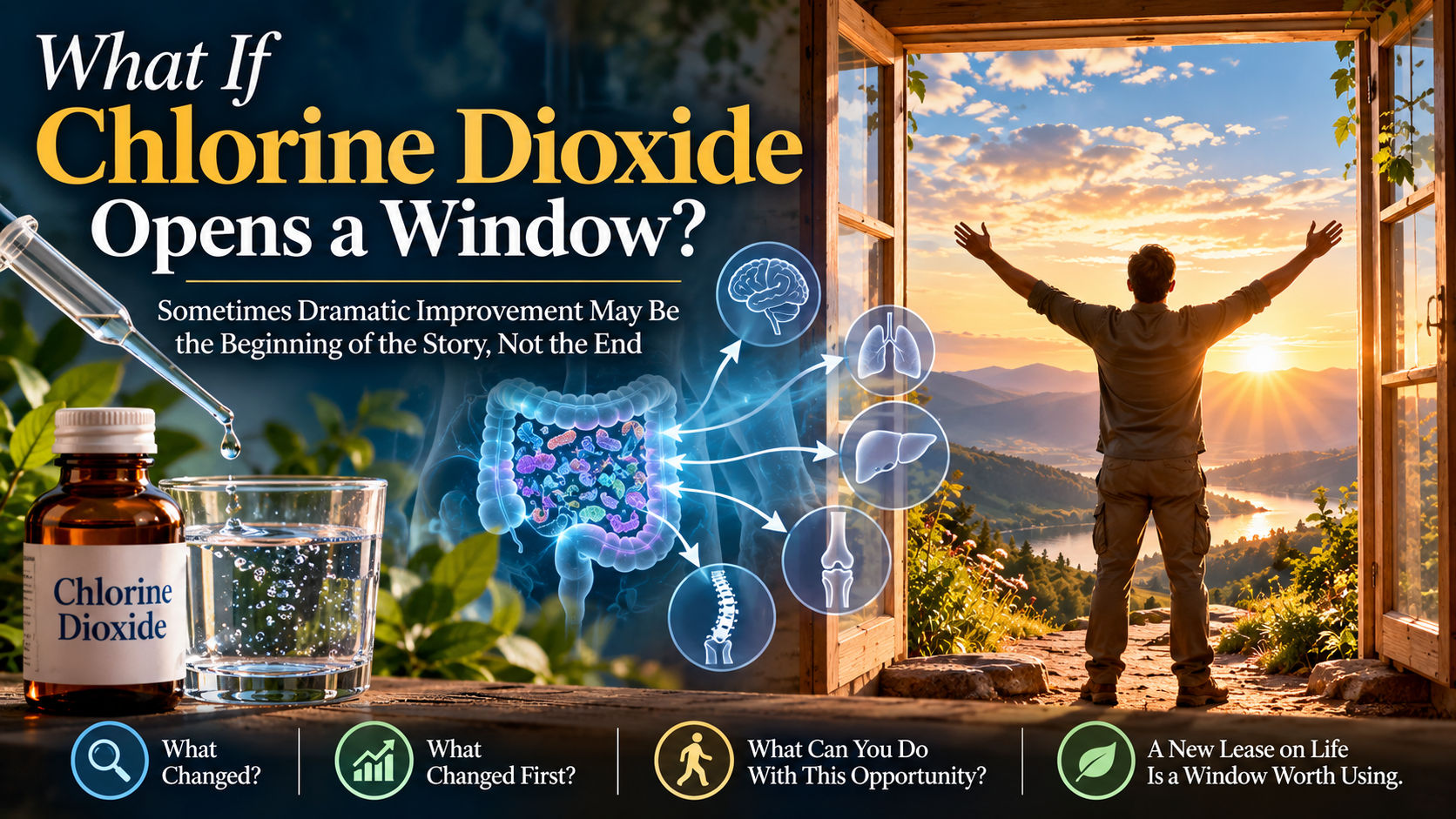
Then Comes the Window
This brings us to something Herb and other natural-health practitioners have encountered repeatedly.
Someone is struggling with a chronic problem.
- They try something.
- They experience a remarkable improvement.
- They celebrate.
- And then they go right back to doing everything they were doing before.
- Same diet.
- Same inactivity.
- Same poor sleep.
- Same stress.
- Same habits.
- Same conditions.
Eventually, the problem returns. And sometimes the response is remarkably casual: “That’s okay. I’ll just do another round.”
Perhaps another round helps. Perhaps it doesn’t.
But there may have been a much larger opportunity sitting unnoticed between those two episodes.
What If the Improvement Was a Window of Opportunity?
Suppose someone has been unable to exercise because they’re exhausted or hurting. Then something changes, and they feel dramatically better.
Suddenly they can move. That’s a window.
- They can begin walking.
- Build muscle.
- Improve circulation.
- Improve metabolic health.
- Perhaps sleep better because they’re active again.
And those improvements can begin influencing still more systems.
Or suppose someone’s metabolic measurements substantially improve. Wonderful. But instead of interpreting that improvement as permission to return immediately to everything that preceded the problem, perhaps it should be interpreted as:
“Something has given me breathing room. What can I change while I have it?”
That’s a very different relationship with an intervention.
Diabetes Illustrates the Problem Particularly Well
Type 2 diabetes is influenced by multiple interacting factors, and remission is possible for some people, particularly following substantial sustained weight loss and metabolic changes.
Now imagine someone using a natural-health intervention and subsequently seeing dramatically improved glucose measurements.
They announce: “I’m cured!”
- Maybe they’ve achieved remission.
- Maybe something else changed simultaneously.
- Maybe their medications, food intake, weight, activity or illness changed.
- Maybe the intervention played some role.
Without proper measurements and controls, we don’t know.
But here’s what we do know: If the person’s metabolic health has substantially improved, something valuable has happened.
Why waste it?
That may be precisely the time to work on nutrition, physical activity, muscle mass, sleep, weight where appropriate, stress, and other modifiable contributors. Because feeling better doesn’t necessarily mean the conditions that helped create the problem have disappeared.
Relief Isn’t Failure
Sometimes people hear this distinction and think we’re diminishing the value of the intervention.
Quite the opposite.
If someone goes from barely functioning to living again, that’s significant whether we call it relief, improvement, remission or cure.
If pain falls enough for someone to begin rehabilitation, that’s valuable.
If fatigue lifts enough for someone to become active, that’s valuable.
If better metabolic control gives someone an opportunity to make sustainable changes, that’s valuable.
An intervention doesn’t have to permanently cure a disease to have profoundly changed someone’s trajectory.
Maybe that’s one of the mistakes we make when discussing natural alternatives.
We demand that something either: CURES THE DISEASE or DOES NOTHING.
There is an enormous amount of territory between those two conclusions.
Don’t Turn the Window Into a Revolving Door
There’s also a strange psychological trap when someone discovers something they believe reliably makes them feel better.
It can become a rescue button.
- Problem returns. Use the thing. Feel better. Return to old behavior.
- Problem returns. Use the thing again.
Eventually, instead of using improvement as an opportunity to change direction, the person uses the intervention to maintain the same direction.
That’s probably not the greatest use of a second chance. A new lease on life is most valuable when we do something different with the lease.
Maybe This Changes How We Read the Old Stories
Herb collected reports because he believed repeated observations mattered. I think they do. But perhaps some of those old stories deserve a slightly different question today.
Instead of: “Did chlorine dioxide cure this disease?” ask: “Did something measurable change?”
Then:
- What changed first?
- What changed next?
- How long did it last?
- What happened when the intervention stopped?
- Did the original problem return?
- Did anything else change during the improvement?
- What did the person do differently once they felt better?
Those questions don’t dismiss the testimonial. They take it seriously enough to investigate it.
The Intervention May Have Opened the Window
Maybe future research will demonstrate that some of these chlorine dioxide reports have explanations unrelated to chlorine dioxide. Maybe some won’t reproduce at all. Perhaps some will reveal genuine biological effects, but the mechanism will be very different from what Herb imagined. That’s what investigation is for.
For now, though, there’s a useful lesson that doesn’t require us to know the answer.
When something appears to produce a meaningful improvement in your health, don’t merely ask: “Did this cure me?” Ask: “What can I do now that I couldn’t do before?”
- Move.
- Rebuild strength.
- Improve nutrition.
- Protect sleep.
- Address stress.
Work on the circumstances that contributed to the problem. Measure what can be measured. Use appropriate professional care. And pay attention to what happens next. Because perhaps the greatest value of an intervention isn’t always that it fixed everything. Maybe it opened the window.
And what happens after that may depend considerably on what we do while the window is open.
Informational notice: This article discusses anecdotal observations and research hypotheses. It does not establish chlorine dioxide as a treatment or cure for diabetes or other chronic diseases, nor does it provide instructions for consuming or applying chlorine dioxide. Chlorine dioxide exposure can pose health risks. Significant health changes should be objectively evaluated when possible, and prescribed treatment should not be discontinued without appropriate professional guidance.