In November 2012, Chinese inventor Liu Xuewu filed a patent proposing an unexpected application for chlorine dioxide. Instead of focusing on its familiar role as a disinfectant, he proposed that chlorine dioxide-containing formulations might stimulate the body’s own stem cells. The invention was based on a concept that continues to attract considerable interest in regenerative medicine: rather than introducing externally cultivated stem cells into damaged tissues, could researchers stimulate stem cells already present in the body?
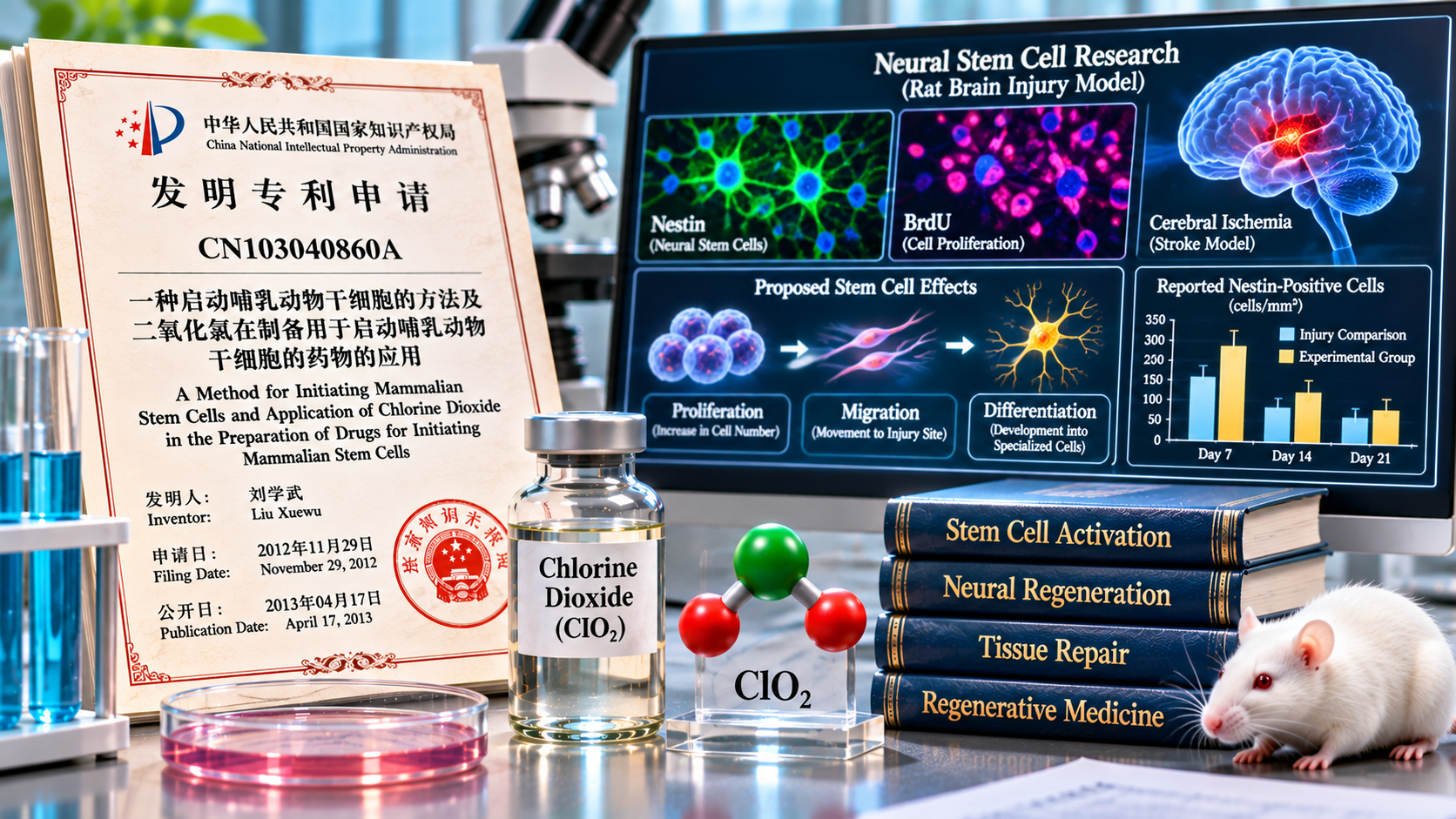
The inventor described three biological processes he hoped to influence: stem-cell proliferation, migration, and differentiation. Proliferation refers to an increase in cell numbers. Migration describes movement toward another location. Differentiation is the process through which a less-specialized cell develops characteristics associated with a particular cell type.
Liu proposed that influencing these processes might help damaged tissues regenerate.
His patent included experiments involving a rat model of cerebral ischemia and reperfusion injury, laboratory measurements of neural stem-cell-associated markers, and reported human observations involving skin disorders, gastrointestinal disease, and other conditions.
The invention was published in China in April 2013 and subsequently entered the international patent system.
It provides an unusually detailed historical example of an attempt to connect chlorine dioxide chemistry with regenerative medicine.
The central scientific question is whether the reported biological changes demonstrate genuine stem-cell activation or reflect other responses to tissue injury and chemical exposure.
The Original Chinese Patent
The principal document is: CN103040860A: A Method for Initiating Mammalian Stem Cells and Application of Chlorine Dioxide in the Preparation of Drugs for Initiating Mammalian Stem Cells The inventor is Liu Xuewu (刘学武). The original Chinese title is: 一种启动哺乳动物干细胞的方法及二氧化氯在制备用于启动哺乳动物干细胞的药物的应用
The patent’s recorded history includes:
| Event | Date |
| Chinese priority and filing | November 29, 2012 |
| Chinese application publication | April 17, 2013 |
| International application filing | October 26, 2013 |
| International publication | June 5, 2014 |
| Chinese patent grant | August 14, 2018 |
The corresponding international application is: WO2014082514A1: Method for Activating Mammalian Stem Cells. The Chinese granted patent is: CN103040860B. The original application contains 18 claims.
Its broadest claim concerns the proposed stimulation of stem-cell proliferation, migration, and differentiation in mammalian tissues. The claims also describe various pharmaceutical formulations and proposed methods of delivering them to tissues.
These claims establish the scope of the inventor’s proposed technology. They do not establish that the proposed biological effects were clinically demonstrated.
Why Stem Cells Were Central to the Invention
Stem cells are important because they can produce additional cells and, under appropriate conditions, develop into more specialized cell types. Different tissues contain different populations of stem cells or progenitor cells. Some help maintain tissues that regularly replace themselves, such as skin and blood.
Others participate in limited repair responses following injury. However, the regenerative capacity of adult human tissues varies considerably.
Skin can repair many injuries, while the adult brain and heart have much more limited abilities to replace certain damaged cells. This difference helps explain why stem-cell research has become an important area of regenerative medicine.
Liu’s invention proposed that chlorine dioxide-containing formulations could influence stem cells already present within damaged tissues.
The proposed benefit would not come from transplanting new stem cells. Instead, the inventor hoped to stimulate biological activity in resident cells. This distinction is fundamental to understanding the patent.
Three Proposed Effects on Stem Cells
The inventor identified three principal biological processes.
- Proliferation
Stem-cell proliferation involves producing additional cells through division.
Following injury, an increase in certain progenitor-cell populations may contribute to repair.
However, cell proliferation alone does not establish regeneration.
The newly produced cells must also survive and perform appropriate biological functions.
- Migration
Migration involves cells moving from one location to another.
In some tissues, progenitor cells respond to injury-associated signals and move toward damaged areas.
The inventor proposed that chlorine dioxide-containing formulations might increase this movement.
- Differentiation
Differentiation involves changes in cell identity and function.
For example, certain neural progenitor cells can develop characteristics associated with neurons or glial cells.
The inventor argued that promoting differentiation could help replace or support damaged tissue.
Together, these three processes formed the biological foundation of the invention.
The patent’s experiments attempted to investigate whether they occurred following exposure to the proposed formulation.
The Most Important Experiment: Brain Injury in Rats
One of the patent’s most substantial experimental sections concerns neurological injury.
The researchers used a rat model of cerebral ischemia and reperfusion. Ischemia occurs when blood flow to a tissue is interrupted. Reperfusion occurs when circulation is restored.
Although restoring blood flow is necessary, the process can also produce additional tissue injury through inflammatory and oxidative mechanisms.
The experimental model involved temporary obstruction of the middle cerebral artery. This is a widely used method for studying aspects of ischemic stroke.
The inventor divided the experimental animals into groups involving brain injury, sham surgery, and the proposed chlorine dioxide intervention.
The patent describes subsequent neurological assessments and laboratory examination of brain tissue. Its stated objective was to determine whether the experimental intervention influenced neural stem-cell-associated activity following injury.
An Important Documentation Detail
The patent’s English translation contains an inconsistency in its description of animal numbers. One passage refers to 12 rats, while a subsequent section describes much larger experimental groups. This discrepancy may reflect a translation problem or an error in the original specification.
It would need to be resolved before attempting to reproduce the experimental design.
Nevertheless, the patent provides specific biological measurements that can be examined independently of that uncertainty.
Measuring Neural Stem-Cell Activity
The researchers examined a region of the brain known as the subventricular zone, or SVZ. This region has been extensively studied because it contains neural stem-cell and progenitor-cell populations in rodents.
The investigators used several biological markers. These included nestin, BrdU, NeuN, and GFAP.
Each marker provides information about particular cellular characteristics.
Nestin
Nestin is a protein frequently associated with neural stem cells and certain progenitor populations.
An increase in nestin-positive cells may indicate changes in these populations.
However, nestin is not exclusive to stem cells. Its expression can also change during tissue injury and repair.
BrdU
Bromodeoxyuridine, or BrdU, is a compound used experimentally to label cells synthesizing DNA.
When cells divide, BrdU can become incorporated into newly synthesized DNA.
Researchers can subsequently identify labeled cells in tissue samples. This makes BrdU useful for investigating cell proliferation.
However, BrdU labeling alone does not prove that a labeled cell is a stem cell.
NeuN
NeuN is commonly used as a marker associated with neurons. It can help researchers identify cells expressing neuronal characteristics.
The presence of NeuN-positive cells does not, by itself, establish that new functional neurons have been generated from stem cells.
GFAP
Glial fibrillary acidic protein, or GFAP, is associated with astrocytes and certain neural stem-cell populations. GFAP expression can increase following brain injury.
Consequently, its interpretation depends on cellular location and the other markers examined.
The inventor used these markers to investigate whether the proposed formulation altered cellular responses following cerebral injury.
Reported Changes in Nestin-Positive Cells
The patent provides numerical measurements of nestin-positive cells in the subventricular zone.
The following values are reported as mean cell counts per square millimeter, with accompanying variation measurements.
| Time after injury | Injury comparison group | Experimental group |
| Day 7 | 210.5 ± 22.3 | 305.2 ± 30.6 |
| Day 14 | 74.5 ± 13.4 | 105.3 ± 15.4 |
| Day 21 | 46.2 ± 6.31 | 63.2 ± 7.55 |
The inventor reported higher nestin-positive cell counts in the experimental group at all three measurement points. The patent interpreted this as evidence of increased neural stem-cell activity.
The persistence of the difference through day 21 was particularly interesting to the inventor because the experimental intervention had ended earlier.
He suggested that the effect might continue after exposure stopped.
What the Measurements Mean
These results document a reported difference in a cell population expressing nestin. That is a measurable biological endpoint.
However, increased nestin expression does not necessarily establish the production of new functional neurons. Nestin-positive populations can include cells responding to injury.
To demonstrate meaningful regeneration, researchers would need to establish the identity, origin, survival, and functional integration of the cells involved.
The patent’s results provide a preliminary observation relevant to neural progenitor biology. They do not conclusively demonstrate restoration of damaged brain tissue.
Reported Changes in Cell Proliferation
The patent also reports BrdU-positive cell counts.
These measurements were intended to investigate whether more cells were entering DNA synthesis and proliferation.
| Time after injury | Injury comparison group | Experimental group |
| Day 7 | 136.56 ± 9.93 | 184.61 ± 12.3 |
| Day 14 | 328.6 ± 12.5 | 496.2 ± 30.6 |
| Day 21 | 279.9 ± 12.8 | 385.3 ± 20.9 |
The inventor reported that BrdU-positive cell counts were higher in the experimental group throughout the observation period. He interpreted this as further evidence of stem-cell proliferation.
The researchers also described cells expressing both BrdU and nestin. This combination is potentially more informative than either marker alone because it identifies proliferating cells with characteristics associated with neural progenitor populations.
However, the patent does not provide sufficient independent cell-lineage evidence to establish that these cells ultimately became mature, functioning neurons.
The findings are consistent with changes in proliferative activity but do not fully establish the biological outcome.
The Differentiation Question
The patent’s third major biological question concerns differentiation. The researchers examined cells expressing NeuN and GFAP. They reported changes in populations associated with neuronal and glial characteristics.
The patent also describes cells carrying both BrdU labeling and GFAP expression.
The inventor interpreted these findings as evidence that proliferating progenitor cells were developing into specialized neural cell types.
This interpretation raises an important scientific question.
How can researchers determine whether a cell displaying a particular marker truly developed from a stem cell?
One approach involves lineage tracing, in which researchers track the descendants of specifically identified cells. Other approaches include examining multiple molecular markers, cellular morphology, electrophysiological properties, and integration into existing tissue.
The patent primarily reports marker-based observations. Those measurements can support a hypothesis about differentiation, but they do not conclusively establish the complete developmental history of the cells.
Did the Rats Show Functional Improvement?
The inventor also described neurological function testing. The experimental animals were assessed for signs of motor and neurological impairment following cerebral ischemia.
The patent reports that animals receiving the proposed formulation showed improved neurological scores compared with the injured comparison group.
The inventor connected these observations to the changes in neural stem-cell-associated markers.
This is an important part of the invention because functional recovery is more meaningful than a change in cell counts alone. However, neurological improvement can occur through multiple mechanisms.
These include changes in inflammation, edema, surviving neural circuits, compensatory behavior, and spontaneous recovery.
Even if functional improvement is reproduced, it would not automatically establish that newly generated neurons caused the improvement.
A stronger investigation would need to connect the cellular changes directly to the observed neurological outcomes.
The Human Observations Described in the Patent
Beyond the animal experiments, the patent contains numerous reports involving human participants. These sections broaden the invention considerably. They address conditions involving skin, joints, the respiratory system, and gastrointestinal tissues.
The inventor interpreted many of the reported improvements as evidence that chlorine dioxide-containing formulations promoted tissue repair.
However, most of these human observations did not directly measure stem-cell proliferation, migration, or differentiation.
That distinction matters. A clinical symptom may improve without demonstrating the mechanism responsible.
The following examples illustrate the breadth of the inventor’s investigation.
Psoriasis: A Reported Comparison Involving 86 Patients
One of the larger human investigations described in the patent involved psoriasis. Psoriasis is an inflammatory skin disease involving immune-system activity and altered skin-cell turnover.
The patent describes 86 participants divided into two groups of 43. One group received the experimental chlorine dioxide-containing preparation. The other received a conventional topical comparison treatment.
The inventor reported:
| Outcome | Experimental group | Comparison group |
| Participants | 43 | 43 |
| Reported recovery classification | 41 | 30 |
| Reported recovery percentage | 95.3% | 69.8% |
The patent also describes follow-up observations concerning recurrence.
Among participants successfully followed for approximately six months, the inventor reported recurrence in 2 of 35 individuals from the experimental group and 23 of 32 from the comparison group.
These are unusually large reported differences.
What Would Be Needed to Evaluate Them?
The patent provides more detail than a simple anecdotal account. However, it does not establish the same evidentiary reliability as an independently published, well-controlled clinical trial.
Important questions include how randomization was performed, whether outcome assessments were blinded, how the comparison treatment was selected, and whether the reported classifications were consistently applied.
The follow-up groups were also smaller than the original groups.
Most importantly for the stem-cell hypothesis, the psoriasis observations did not directly demonstrate stem-cell activation.
The inventor proposed that tissue regeneration explained the reported improvement.
That remains an interpretation rather than a measured cellular mechanism.
Rhinitis: Another Reported Clinical Comparison
The patent describes an investigation involving chronic or allergic rhinitis.
The inventor compared the proposed chlorine dioxide preparation with a conventional nasal medication.
The reported results favored the experimental group.
However, the document contains an important inconsistency. One passage describes 30 participants divided into two groups of 15. The results table subsequently lists 30 participants in each group. This discrepancy makes it difficult to reconstruct the actual study population.
The patent also does not establish direct measurements of nasal tissue regeneration or stem-cell activity.
The reported symptom outcomes therefore cannot independently verify the proposed regenerative mechanism. The discrepancy in participant numbers is another reason why the original clinical records would be valuable.
Gastric Ulcers and Helicobacter pylori
The patent also describes an investigation involving 90 individuals with peptic ulcers and Helicobacter pylori infection. The participants were reportedly divided into three groups of 30.
The inventor compared the experimental formulation with two established medication combinations.
The patent describes observations involving gastrointestinal symptoms, ulcer healing, and testing for H. pylori.
The inventor argued that the formulation might have two effects.
One was antimicrobial activity.
The other was the proposed stimulation of tissue regeneration.
This distinction is scientifically important.
Reducing microbial infection and promoting tissue repair are different biological processes. An improvement in ulcer healing does not establish which mechanism was responsible.
The patent does not provide direct evidence that gastric stem cells were activated.
Its findings therefore remain reported clinical observations accompanied by a proposed explanation.
Other Reported Applications
The patent contains additional examples involving:
- Alopecia areata and hair growth
- Skin wounds and scars
- Eczema
- Ankylosing spondylitis
- Experimental diabetes in mice
- Postoperative respiratory complications
These examples reflect the inventor’s belief that stimulation of tissue repair might have applications across multiple organ systems.
However, the evidence differs considerably between examples.
- Some involve animal models.
- Others involve small human case series.
- Several rely on clinical observations rather than direct measurements of stem-cell biology.
The patent therefore should not be interpreted as demonstrating a single regenerative mechanism across all the conditions described.
A Central Question: What Actually Causes the Biological Response?
Chlorine dioxide is a chemically reactive oxidizing agent. In living tissues, oxidizing substances can interact with proteins, lipids, and other biological molecules. These interactions may influence cellular signaling. However, they can also cause tissue injury.
This creates a fundamental challenge when interpreting the patent.
If a tissue responds to chemical exposure by increasing cell proliferation, is the substance directly stimulating stem cells?
Or is the tissue mounting a repair response to chemical injury? Both possibilities could produce changes in certain cellular markers.
A third possibility is that the observed differences involve inflammatory or stress-related signaling rather than stem-cell activation.
Distinguishing among these mechanisms requires experiments designed to separate chemical injury from specific biological regulation.
The patent’s observations raise this question but do not resolve it.
Why the Formulation Chemistry Matters
Another important issue is the chemical composition of the preparations used. The patent describes formulations produced through reactions involving chlorine dioxide precursors and acidic components. Such systems may contain several chemically distinct substances.
The final composition can depend on reaction conditions, pH, storage, and the presence of other materials.
Consequently, observing a biological effect following exposure to a formulation does not necessarily establish that chlorine dioxide alone caused it.
A rigorous investigation would require chemical characterization of the actual material used in each experiment. This would include identifying relevant chlorine oxycompounds and other reaction products.
The distinction becomes particularly important when comparing different experiments or patents.
A result involving one formulation cannot automatically be generalized to every chlorine dioxide preparation.
The International Patent History
The 2012 Chinese invention subsequently entered the international patent system. The corresponding international application was published as: WO2014082514A1
The invention also proceeded through several national and regional patent systems.
Related records include:
- US20150335678A1: United States Patent Application
- EP2926819B1: European Patent
- JP6141997B2: Japanese Patent
The existence of these records demonstrates that the inventor pursued protection beyond China. Patent grants in different jurisdictions can be significant milestones in an invention’s legal history. However, they do not represent independent clinical confirmation.
Patent offices evaluate inventions under patent-law requirements, which differ from the requirements used to establish pharmaceutical safety and effectiveness.
The Chinese patent was granted in August 2018. Its current database status is listed as expired for fee-related reasons, although official records should be consulted for authoritative legal-status information.

The Connection to Later Chlorine Dioxide Research
This invention is especially interesting because Liu Xuewu continued developing related concepts.
In December 2013, he filed another Chinese patent: CN103720709A: Cell Apoptosis Inducer Containing Chlorine Dioxide
That invention investigated programmed cell death, scar-tissue fibroblasts, cancer-cell lines, and aging-related observations.
In March 2016, Liu Xuewu and Liu Xueyan filed: CN105726469A: Chlorine Dioxide Containing Injection and Preparation Method Thereof
The later patent described animal experiments involving formulation toxicity, melanoma tumor growth, and proposed immune-mediated effects. Together, these inventions reveal an evolution in the inventor’s research interests.
- The 2012 patent focused on promoting stem-cell-associated activity and tissue regeneration.
- The 2013 patent focused on apoptosis and the removal of unwanted cells.
- The 2016 patent explored tumor injury and possible immune responses.
These concepts are related through their interest in cellular survival, tissue repair, and biological responses to chemical exposure. However, they involve different mechanisms.
Stimulating stem-cell proliferation is not the same as inducing apoptosis.
Neither is equivalent to generating tumor-specific immunity. The patent history documents the development of these ideas, not proof that all three mechanisms were achieved.
What the 2012 Patent Establishes
The patent provides a substantial primary record of inventive activity.
- It establishes that Liu Xuewu proposed chlorine dioxide-containing formulations for mammalian stem-cell activation in November 2012.
- It documents experiments involving a rat cerebral ischemia model.
- It reports higher counts of nestin-positive and BrdU-positive cells in experimental groups.
- It describes additional measurements involving neural and glial markers.
- It reports neurological functional observations.
- It also contains human case series and comparisons involving several diseases.
- Finally, it documents the invention’s progression through international patent systems.
These findings make the patent historically and scientifically interesting. However, the patent does not conclusively establish that chlorine dioxide selectively activates stem cells, regenerates damaged organs, or provides safe and effective treatment for the diseases described.
The strongest evidence presented concerns reported changes in biological markers following experimental brain injury.
The broader regenerative interpretation requires additional investigation.
Questions for Future Research
Several questions deserve closer examination.
Were the rat stroke experiments published independently?
A peer-reviewed report might provide clearer animal numbers, complete methods, and additional statistical analysis.
Can the reported increases in nestin-positive and BrdU-positive cells be reproduced?
Independent replication would help establish whether the observed differences are consistent.
Did the newly labeled cells become functional neurons?
Lineage-tracing and functional studies would help determine whether genuine neural regeneration occurred.
Were the changes caused by stem-cell stimulation or by a response to chemical injury?
Experiments separating these mechanisms would be particularly informative.
What was the precise composition of the experimental preparations?
Chemical characterization could help identify which substances were responsible for observed effects.
Can the reported human clinical comparisons be independently documented?
Original records would help resolve inconsistencies involving participant numbers and outcome measurements.
Did later researchers investigate the proposed regenerative mechanism?
Patent citations, journal publications, and subsequent experimental studies could reveal whether the hypothesis was pursued beyond the inventor’s original work.
These questions provide a specific research agenda grounded in the patent’s disclosures.
Conclusion
The Chinese patent CN103040860A represents an early attempt to investigate chlorine dioxide-containing formulations in regenerative medicine. Filed in November 2012 by inventor Liu Xuewu, the invention proposed stimulating mammalian stem-cell proliferation, migration, and differentiation. Its most substantial experimental evidence involved a rat model of cerebral ischemia and reperfusion injury.
The inventor reported increased numbers of cells expressing markers associated with neural stem cells and proliferation, along with neurological functional observations.
The patent also described human observations involving psoriasis, rhinitis, gastrointestinal ulcers, and other conditions. These reports expanded the proposed applications but did not directly establish stem-cell activation in human tissues.
The invention subsequently entered international patent systems and was granted in China, Europe, and Japan. Its historical importance extends beyond the original application.
The patent preceded Liu Xuewu’s later investigations involving apoptosis, cancer cells, melanoma, and proposed immune responses.
Together, these inventions document a sustained effort to explore how chlorine dioxide-containing formulations might influence cellular processes beyond conventional disinfection.
The central question remains whether the reported biological changes represent specific regenerative mechanisms or more general responses to chemical exposure and tissue injury.
That question can only be answered through experiments capable of distinguishing stem-cell activation from other forms of cellular stress and repair.
For researchers interested in regenerative medicine, stem-cell biology, pharmaceutical patents, and the history of chlorine dioxide research, the 2012 invention provides a detailed and unusual primary source for further investigation.
Primary Sources and Further Reading
- Original Chinese patent application
Inventor: Liu Xuewu. Filed November 29, 2012. Published April 17, 2013.
- Original Chinese-language document
CN103040860A: Chinese Patent Text
Original patent language, experimental descriptions, and numerical tables.
- Granted Chinese patent
Granted August 14, 2018.
- International patent publication
International publication of the stem-cell-related invention.
- European patent
European member of the patent family.
- Japanese patent
Japanese member of the patent family.
- United States patent application
American publication associated with the invention.
- Related apoptosis patent
Liu Xuewu’s subsequent investigation involving programmed cell death.
- Related melanoma patent
Later invention involving melanoma experiments and proposed immune responses.
- World Intellectual Property Organization
International patent records and original application documents.